 Floor
Floor
Screeding
For Independent Builders To
Large Construction Companies

Specialists In Traditional /
Flowing Screeds
For Independent Builders To
Large Construction Companies
External Walls & Property
Rendering
Making Cold Floors
A Thing Of The Past
Welcome to Mitchell Plastering & Dry Lining Ltd. We specialise in floor screeding, plastering, dry lining, rendering and underfloor heating. Centrally based in Derbyshire, we undertake projects for commercial and industrial clients throughout the Midlands and the rest of the UK.
Our qualified tradesmen have over 20 years of industry experience, competing all work efficiently to the absolute highest standards. We offer free site surveys across the UK and provide valuable advice on floor screeding, underfloor heating, plastering and rendering works.
Thank you to the team at Stuart Mitchell's. From the initial call, site visits, actual work and follow up care we have been so impressed by them and not to mention the final product. The professionalism and attitude were beyond our expectations along with the competitive pricing. We will definitely be using them again and recommend to all.
Very helpful and polite. Supply and fix pump placed Tarmac liquid screed to house extension.
They are good people, I have used them for a long time. Supply and fix 350m2 at 50mm pump placed cement based fast drying liquid screed to ground and upper floors.
Thank you to the team at Stuart Mitchell's. From the initial call, site visits, actual work and follow up care we have been so impressed by them and not to mention the final product. The professionalism and attitude were beyond our expectations along with the competitive pricing. We will definitely be using them again and recommend to all.
Very helpful and polite. Supply and fix pump placed Tarmac liquid screed to house extension.
They are good people, I have used them for a long time. Supply and fix 350m2 at 50mm pump placed cement based fast drying liquid screed to ground and upper floors.

Floor screed failures on large commercial projects are more common than they should be, and the consequences are rarely minor. A failed screed can delay the entire programme, hold up subsequent trades, require costly re...
Click Here
We were recently brought in to carry out a specialist floor screeding and underfloor heating installation as part of a private renovation project at an older property in Draycott, Derbyshire. The existing floor had been...
Click Here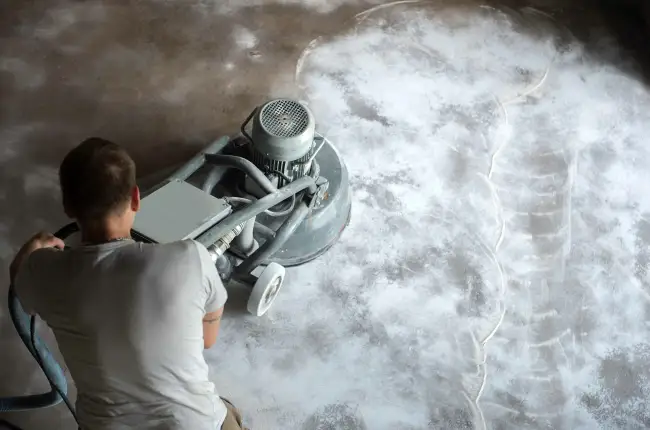
Floor screed is only as good as the surface it is laid on. No matter how well a screed is mixed, pumped and finished, if the subfloor beneath it has not been properly prepared, the finished result will be compromised. P...
Click HereThese three terms describe how the screed relates to the substrate beneath it. Bonded screed is mechanically or chemically fixed directly to the concrete subfloor using a bonding agent such as SBR or epoxy, and can be laid as thin as 10mm.
Unbonded screed sits on top of a separating membrane rather than adhering to the base, and should be laid at a minimum depth of 50mm for traditional cement-based mixes. Floating screed is laid over insulation or underfloor heating pipework and is not connected to the substrate at all, making it the standard choice for thermally efficient new-build floors.
Drying times vary depending on the type of screed and its thickness. Traditional sand and cement screed dries at approximately 1mm per day up to 50mm depth, meaning a 75mm screed could take over two months to reach the moisture levels required for floor finishes. Liquid anhydrite screed dries at roughly 1mm per day to 40mm and 0.5mm per day beyond that, so a 50mm anhydrite bed typically takes around 60 days under normal UK site conditions. Regardless of screed type, a moisture test using a hygrometer should always be carried out before any final flooring is installed.
Laitance is a thin, weak layer of fine particles that rises to the surface of anhydrite and calcium sulphate screeds as they cure. It looks like a dusty or powdery coating and, if left in place, will prevent tile adhesive from bonding properly to the screed beneath. This is one of the most common causes of tile failure on liquid screeded floors.
Laitance should be removed by machine sanding, typically 7 to 10 days after the screed has been poured, before the floor is primed and prepared for tiling. The surface must then be vacuumed thoroughly and, in most cases, sealed with an appropriate epoxy primer before any adhesive is applied.
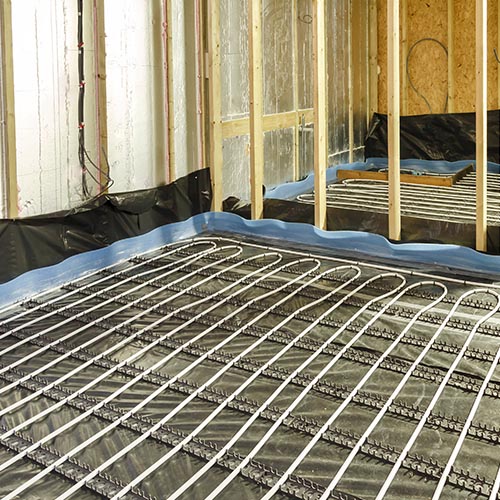
Yes. There is a widely held belief in the industry that liquid flowing screed is the only suitable choice for underfloor heating, but this is not accurate. Traditional fibre-reinforced sand and cement screed can be laid over underfloor heating pipework successfully, provided the mix is correctly proportioned and the right technique is used to ensure full encasement of the pipes.
Traditional screed also provides an excellent surface for tiling without the laitance removal and priming steps that anhydrite screeds require.
The screed must cure for a minimum of seven days before the underfloor heating system is switched on. Once that period has passed, the flow temperature should start at around 20 to 25 degrees Celsius and be increased gradually by no more than 5 degrees per day until the system reaches its maximum working temperature.
That maximum temperature should then be held for at least one week to assist with drying. After this, the temperature is reduced gradually back down to ambient before the heating is turned off entirely ahead of tiling. Switching the system on too early, or increasing temperatures too quickly, risks cracking and curling of the screed.
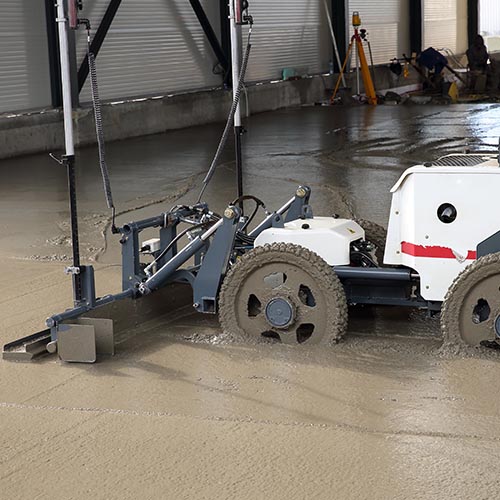
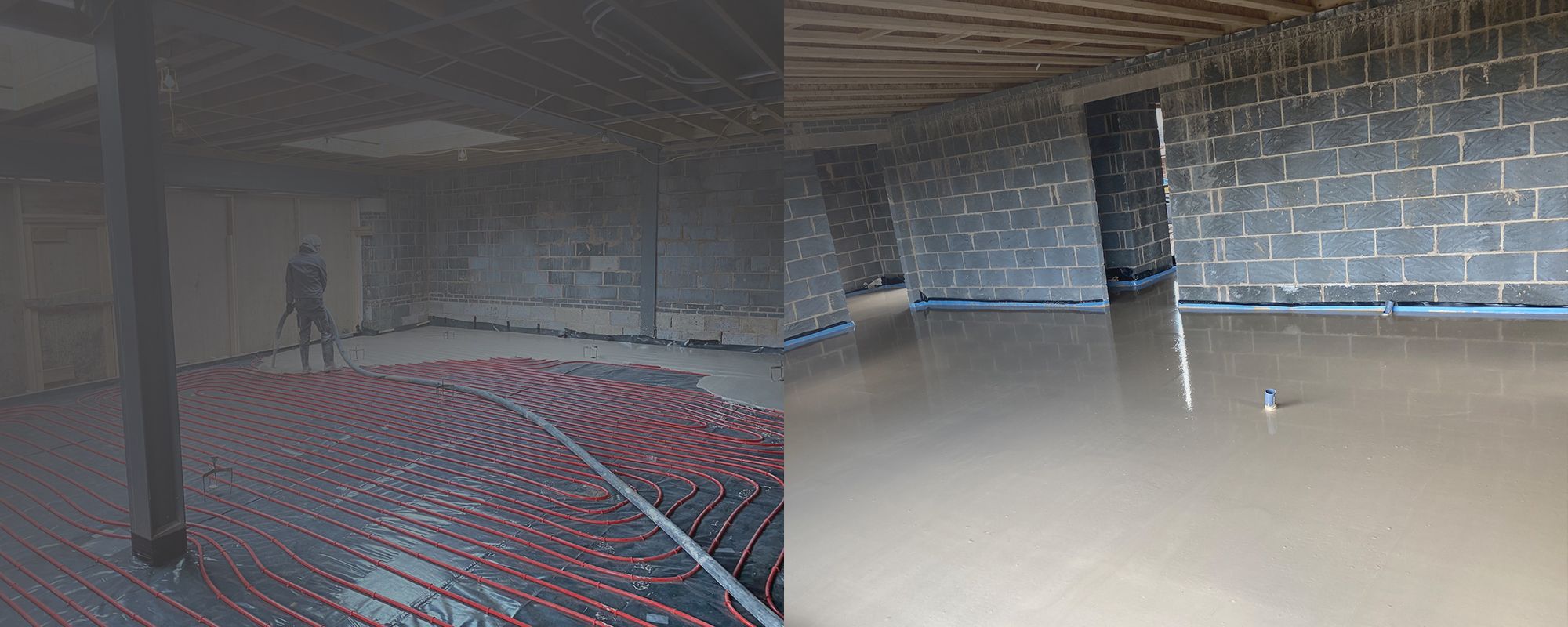
Pump-applied screed is delivered to the floor via a hose and pump rather than being mixed and laid by hand. It allows very large surface areas to be covered quickly and efficiently, with a consistent mix throughout. Where a team of traditional screeders might cover 100 to 150 square metres in a day, a pump-applied liquid screed system can lay up to 2,000 square metres in the same period.
For large commercial and industrial projects, this makes pump-applied screed significantly more cost-effective, with far less disruption to the wider construction programme.
Cracking occurs when screed dries too quickly, causing the material to shrink unevenly as moisture escapes. Curling is a related issue that typically appears along day joints and internal angles, and is more common in thinner screeds where the top surface dries faster than the bed beneath it.
Both problems can be significantly reduced by avoiding artificial acceleration of drying, keeping the building at a consistent temperature and humidity level during the curing period, and using polypropylene fibres within the screed mix. Water-reducing agents known as superplasticisers can also be used to reduce the water-to-cement ratio and lower the risk of shrinkage.
For a standard domestic floor with no underfloor heating, a traditional unbonded sand and cement screed at 65 to 75mm is the recommended specification. Where underfloor heating pipework is present, the screed depth is usually determined by the pipe diameter plus a minimum cover of 25 to 30mm above the pipes.
For liquid anhydrite screeds over underfloor heating, a minimum depth of 30mm above the pipe crown is typically required. The exact specification should always be confirmed based on the subfloor condition, the floor finish being applied and whether insulation is being incorporated beneath the screed.
The industry standard for floor screed flatness is a maximum deviation of 5mm over a 3-metre straight edge, in accordance with BS 8204. For projects where the final floor finish is particularly sensitive to variation, such as large-format tiles or engineered timber, a tighter tolerance of 3mm or better across the entire screeded area is achievable and should be specified from the outset.
If a floor is subsequently found to be out of tolerance, it can be corrected using grinding, self-levelling compounds or feather-edge repair products depending on the extent of the deviation.
Fast-drying screed is a cement-based product formulated with accelerating agents that significantly reduce the time before floor finishes can be laid. Fast-drying screed is suitable for both domestic and commercial applications and can be laid over underfloor heating systems. It does carry a cost premium over standard mixes, so it is best used where the programme benefit justifies the additional spend.
Yes. The condition of the subfloor has a direct bearing on the quality of the finished screed. For bonded applications, the concrete base must be mechanically prepared (typically by shot blasting or grinding), to open up the surface and allow the bonding agent to penetrate effectively. For unbonded and floating applications, the surface must be clean, free from debris and covered with an appropriate separating membrane before screeding begins. Where the subfloor shows signs of contamination from oil, paint or existing adhesive residue, these must be removed prior to installation. A poorly prepared subfloor is one of the most common causes of screed delamination and premature failure.
Yes, floor screed can be applied to upper floors, including beam and block, pre-cast concrete and timber suspended floor structures, provided the structural loading capacity has been confirmed as adequate.
Liquid anhydrite screed is often favoured for upper-floor applications due to its lower density compared with traditional sand and cement mixes, which reduces the dead load on the structure. Where a beam and block or timber floor is involved, the specific screed system and depth must be selected to remain within the structural engineer's permitted loading.
Before any screed is laid, the underfloor heating circuit must be pressure tested to confirm there are no leaks in the pipework. The system is typically pressurised to 1.5 to 2 times its working pressure and held for a minimum period, usually a minimum of 24 hours, to demonstrate integrity. The system is then left pressurised throughout the screeding process so that any damage to the pipework caused during laying can be detected immediately. Mitchell Plastering & Dry Lining Ltd work with underfloor heating systems installed by third parties as well as supplying and installing their own, and always require pressure test confirmation before screeding work begins.
Not every failing screed needs to be taken up and replaced. In many cases, a weak or dusting screed can be consolidated using penetrating hardener products, which are applied to the surface and react chemically with the screed to significantly increase surface strength.
Hairline cracks can often be filled with flexible repair compounds without compromising the structural integrity of the floor. Full replacement becomes necessary where the screed has delaminated from the substrate, where cracking is widespread and structural, or where the depth of the existing screed is below the minimum required specification. Mitchell Plastering & Dry Lining Ltd can assess any failing screed and advise on the most commercially viable course of action, whether that is repair or replacement.
 Plastering &
 Rendering
 Underfloor